Games / Persona
Persona Games in Order: Releases, Remakes and Spin-offs
Find Persona games in release order, choose between Golden, Royal and Reload, and see how major spin-offs and upcoming Persona titles fit.
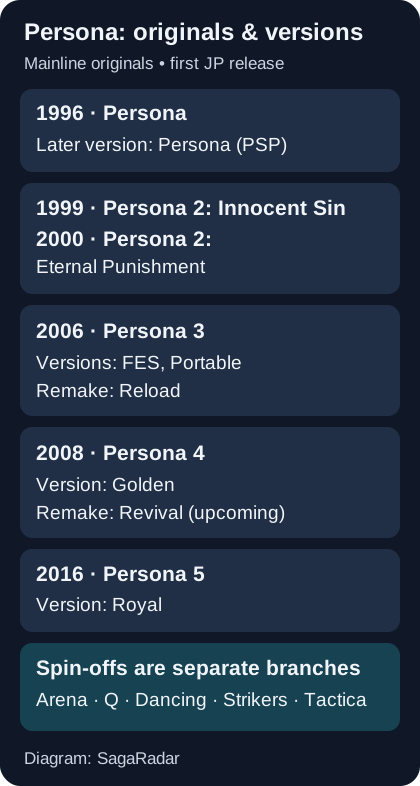
Start Persona with Persona 3 Reload, Persona 4 Golden or Persona 5 Royal—their original editions are not required first. Pick the setting and cast that interest you, rather than treating the release list as homework. If you want the series from its beginnings, follow Persona → Persona 2: Innocent Sin → Persona 2: Eternal Punishment → Persona 3 → Persona 4 → Persona 5.
Historical dates below are first Japanese releases, not US launch dates. The tables separate original games, alternative versions and spin-offs; upcoming releases have their own section.
In this guide
Which Persona order do you need?
For a first modern Persona RPG, all three choices mix everyday relationships with turn-based battles. The difference is the kind of story and dungeon routine you want to spend time with:
| Start with | Choose it for | Know before you buy |
|---|---|---|
| Persona 3 Reload | A school team investigating the Dark Hour, with repeated expeditions up the tower of Tartarus. | The tower is a recurring part of the routine, not a series of Royal-style Palaces. Episode Aigis is a separate expansion. |
| Persona 4 Golden | A small-town murder mystery and a group of friends investigating the TV world. | This is an expanded older game, not a modern remake. Choose it for that cast and mystery, rather than expecting Reload’s presentation. |
| Persona 5 Royal | Tokyo life, the Phantom Thieves and infiltration of distinctive Palaces. | It expands Persona 5; buying or finishing the original first adds an unnecessary step for this starting route. |
These are starting-point recommendations, not a ranking of the three games. If Reload is your pick, compare the Standard, Digital Deluxe and Digital Premium editions to see which extras you need before buying.
For a different goal, use one of these routes:
- Follow the series from its beginnings: use the original release order, treating later versions as choices within each entry.
- Follow a particular cast: finish its numbered game before moving to the related spin-offs. A crossover can draw on more than one cast.
Story chronology is a different question. A spin-off set around an earlier adventure need not be inserted halfway through that adventure. The practical rule here is to meet the main cast in its own game first. The notable early-series connection is Persona 2: Innocent Sin followed by Eternal Punishment, which are two distinct games, not two editions of the same one.
Persona games in original release order
These are the six original mainline releases through Persona 5. The count is six because Persona 2 consists of two separately released titles. English names are used to identify the games; the year and hardware columns follow the Japanese history in the official Persona anniversary catalog.
Scroll sideways to see all columns →
| Order | Original game | First JP release | Original hardware |
|---|---|---|---|
| 1 | Persona | 1996 | PlayStation |
| 2 | Persona 2: Innocent Sin | 1999 | PlayStation |
| 3 | Persona 2: Eternal Punishment | 2000 | PlayStation |
| 4 | Persona 3 | 2006 | PlayStation 2 |
| 5 | Persona 4 | 2008 | PlayStation 2 |
| 6 | Persona 5 | 2016 | PlayStation 3 and PlayStation 4 |
The first game also appears under the English titles Revelations: Persona and Shin Megami Tensei: Persona. Those names do not add two more mainline entries. Its 2009 PSP version belongs to the same first-game family.
Persona 2 needs extra care when shopping in English. Innocent Sin received its official North American English release on PSP in 2011. Eternal Punishment received an English PlayStation release in 2000, but its later PSP version was not localized into English. ATLUS explains that distinction in its Eternal Punishment release history. Do not assume an imported PSP copy has English because the other half of Persona 2 does.
The list is a guide to the main series and major related console, PC and mobile releases, not every Japanese feature-phone title, arcade revision or guest appearance in another franchise.
Where FES, Portable, Golden, Royal and Reload fit
Expanded versions and remakes revisit an existing numbered game. Choose one for your first playthrough; playing the original is not a prerequisite.
Scroll sideways to see all columns →
| Family | Version | First JP year | How it fits |
|---|---|---|---|
| Persona 3 | Persona 3 FES | 2007 | Expanded version of Persona 3 |
| Persona 3 | Persona 3 Portable | 2009 | Alternative version originally made for PSP |
| Persona 3 | Persona 3 Reload | 2024 | Remake of Persona 3 |
| Persona 4 | Persona 4 Golden | 2012 | Expanded version of Persona 4 |
| Persona 5 | Persona 5 Royal | 2019 | Expanded version of Persona 5 |
Persona 3: different versions, not three sequels
FES, Portable and Reload revisit Persona 3. Their subtitles are not a prescribed play order, and “newer” does not mean every feature from every earlier version is included. Portable offers two protagonist perspectives. Reload should not be treated as a bundle containing Portable’s complete alternative experience.
For Reload’s epilogue, add Episode Aigis through the compatible expansion after the base story. It is not a new numbered game and is not automatically included just because an edition is called Premium.
Persona 4 Golden and Persona 5 Royal
Golden expands Persona 4; Royal expands Persona 5. Both can be played without first finishing the original version. Golden’s 2012 Vita debut and later port dates refer to the same version family.
The same distinction applies to Royal’s 2019 Japanese PS4 debut and its later multiplatform release. Package contents can still differ by platform: the Persona 5 Royal DLC guide deals with that purchasing question separately.
Persona spin-offs: release order and related games
These titles are separate games, unlike Royal or Reload. The table follows their first Japanese console releases; the Arena games’ arcade releases are outside that convention. The relationship column identifies the cast or branch, not a precise date in a single universal timeline.
Scroll sideways to see all columns →
| First JP year | Game | Format | Related branch |
|---|---|---|---|
| 2012 | Persona 4 Arena | Fighting game | Persona 3 and 4 |
| 2014 | Persona Q: Shadow of the Labyrinth | Dungeon RPG | Persona 3 and 4 |
| 2014 | Persona 4 Arena Ultimax | Fighting game | Follow-up to Arena |
| 2015 | Persona 4: Dancing All Night | Rhythm game | Persona 4 |
| 2018 | Persona 3: Dancing in Moonlight | Rhythm game | Persona 3 |
| 2018 | Persona 5: Dancing in Starlight | Rhythm game | Persona 5 |
| 2018 | Persona Q2: New Cinema Labyrinth | Dungeon RPG | Persona 3, 4 and 5 |
| 2020 | Persona 5 Strikers | Action RPG | Persona 5 cast |
| 2023 | Persona 5 Tactica | Tactical RPG | Persona 5 cast |
| 2025 | Persona 5: The Phantom X | Mobile and PC RPG | Persona 5 spin-off with a new protagonist |
The Phantom X row uses its Japanese release year, consistent with the rest of the table; it is not a claim that every region first received the game in 2025.
Arena and Arena Ultimax
For story order, meet the Persona 3 and Persona 4 casts first, then follow Arena’s story before Ultimax’s continuation. That does not necessarily require two purchases. The 2022 release of Persona 4 Arena Ultimax includes Episode Persona 4 Arena, so check the exact version instead of buying an older Arena copy just to complete the sequence.
Q, Q2 and the Dancing games
Q brings together characters from Persona 3 and Persona 4; Q2 expands the crossover to Persona 5 and includes Portable’s protagonist. The cast list is the useful preparation guide. It is not a reason to interrupt the middle of several numbered games to construct an exact calendar order.
Choose a Dancing game after meeting its named cast. These rhythm-game spin-offs are optional, not replacements for the main RPGs.
Strikers, Tactica and The Phantom X
Strikers reunites the Persona 5 cast for a summer road trip. Tactica is a separate tactical adventure with those characters. Finish Persona 5 or Royal before using either as your next step; this lets you meet their returning characters first. You do not need to treat every Royal-specific addition as a prerequisite for both spin-offs.
Tactica’s Repaint Your Heart is DLC within Tactica, not another standalone game to add to this table. Its package distinctions are covered in the Persona 5 Tactica DLC guide. The Phantom X is another separate title, not Persona 6 and not an expansion you install into Royal.
Which versions are available on your platform?
Original hardware and current ports answer different questions. This short list identifies the modern releases of four commonly confused versions. It lists native release platforms, not every newer console that might run an older version through compatibility.
| Version | PC releases | Console releases |
|---|---|---|
| Persona 3 Portable | Steam and Windows | PS4; Xbox One and Series X|S; Nintendo Switch |
| Persona 4 Golden | Steam and Windows | PS Vita; PS4; Xbox One and Series X|S; Nintendo Switch |
| Persona 5 Royal | Steam and Windows | PS4 and PS5; Xbox One and Series X|S; Nintendo Switch |
| Persona 3 Reload | Steam and Windows | PS4 and PS5; Xbox One and Series X|S; Nintendo Switch 2 |
Reload arrived on Switch 2 on October 23, 2025, not on the original Switch. Confirm the console generation and supported language on your regional store before buying.
How the games connect to Persona anime
Anime adaptations sit outside the game release list. If you want to follow the Persona 5 cast on screen, the Persona 5 anime watch order places its television episodes, specials and OVAs in sequence. They are adaptations and related viewing, not additional game installments.
Upcoming Persona games
These announced games remain separate from the released catalog as of September 11, 2026.
Persona 4 Revival
SEGA’s Asia English page for Persona 4 Revival describes a remake of Persona 4 Golden and lists February 18, 2027 for PS5, Xbox Series X|S, Windows and Steam, followed by May 20, 2027 for Nintendo Switch 2. These dates describe that regional announcement; confirm your country’s storefront when planning a purchase.
Golden is a released option you can play now. Revival is an upcoming alternative in the same Persona 4 family, so do not buy it expecting the next chapter after Golden.
Persona 6
The Persona 6 website lists Xbox Series X|S, Windows, PS5, Steam and Nintendo Switch 2. As of September 11, 2026, it has wishlist links but no release date.
What do you think?
0 Responses
Choose a reaction. Tap it again to undo.
Keep reading